01 December 2025

AA Members’ views on vehicle safety technology

Insights from AA Members on safety requirements for vehicle imports

New Zealand’s road safety record is worse than many comparable countries, with hundreds of deaths and thousands of serious injuries each year. One reason is that our vehicle fleet is older and often lacks the latest safety features now standard in new cars overseas. 

The AA ran a Vehicle Safety Survey in October 2025 ahead of the Government consulting on possibly requiring certain advanced safety technologies - such as Automatic Emergency Braking and Lane Keeping Assist - in all new and used vehicles imported into New Zealand.

The Vehicle Safety Survey had a response rate of 55% (2,068 responses from 3,821 Members invited), with a margin of error of ±1%. 

Key findings

What AA Members think about vehicle safety technology

What is modern vehicle safety technology?

Modern vehicle safety technologies use sensors, cameras, and automated responses to help drivers avoid crashes or reduce their severity. Some systems warn the driver about hazards, while others intervene automatically to prevent or minimise a collision. These technologies are increasingly standard in vehicles overseas and are linked to lower crash rates.

This survey asked about the following technologies:

  • Automated Emergency Braking (AEB): This brakes automatically if the vehicle detects a collision risk.
  • Anti-lock Braking System (ABS): Prevents wheels locking under hard braking.
  • Driver Distraction / Drowsiness Monitoring: Monitors driver attention and warns if they are drowsy or distracted.
  • E-call (Automated Emergency Call): Automatically connects to a support centre after a serious crash, which then contacts emergency services and provides the location.
  • Emergency Stop Signal: Rapidly flashes brake or hazard lights under emergency braking to warn other drivers.
  • Event Data Recorder (“black box”): Records vehicle data before and during a crash for investigation.
  • Rear or Side Object and Pedestrian Detection: This detects people or objects behind or around the car and warns the driver.
  • Intelligent Speed Assistance (ISA): Uses cameras or maps to know the speed limit, warns if speeding, and can limit speed unless overridden.
  • Lane Keeping Assist / Lane Departure Warning: Alerts the driver or gently steers if the car drifts out of its lane.
  • Speed sign recognition:  Uses cameras to detect speed limit signs and shows the current speed limit on your dashboard.

AA Members' use of vehicle safety technology

Half of AA Members have vehicle safety technology

We wanted to understand how common vehicle safety technology is.

Just under half of AA Members (49%) had at least one of the common vehicle safety technologies in the vehicle they use most for personal travel, while just over half (51%) say their car has none of the common vehicle safety technology we surveyed.

The most common technologies were:

  • Adaptive Cruise Control – 4 in 10 AA Members (38%).
  • Lane Keeping Assist/Lane Departure Warning – 3 in 10 (34%) of Members' vehicles have this technology. This technology alerts the driver or gently steers if the car drifts out of its lane.
  • Automatic Emergency Braking/AEB - 3 in 10 (33%) of Members’ vehicles have this technology. AEB brakes automatically if the vehicle detects a collision risk.

Most AA Members leave vehicle safety technology switched on

We also asked AA Members how often they use their vehicle safety technology:

We found that most AA Members keep their safety technology switched on.

  •  Just over half (54%) always leave their safety tech turned on, while a quarter (24%) usually leave it on, but sometimes switch it off.
  •  1 in 10 (9%) usually turn it off, and 6% never use it.

AA Members reported that vehicle safety features that automated their driving sometimes caused safety issues:

“Lane Assist won't work in Aotearoa until we fix our roads. I've driven a few vehicles on Auckland roads this year and have had to turn lane assist off every time – it picks up those little black repair lines, it picks up fake lines, it picks up old lines that have been painted over... it's a nightmare.” - AA Member

"Some of the current automated responses in newer cars seem to be set with excessive triggers. For instance when reversing out of a drive, my car will suddenly brake when a car appears in the distance on the road. I have seen the approaching car, but the sudden sharp braking by my car throws me onto the steering wheel. In my view this sudden sharp braking is dangerous.” - AA Member

Do AA Members trust vehicle safety technology?

Over half of AA Members trust vehicle safety technology to be reliable

We wanted to understand whether people think vehicle safety technology is reliable.

We found that:

  • Over half (54%) trust that vehicle safety technology would work reliably in their car. 18% disagreed.


 “After driving some of the new cars with the modern cars I have found they are actually more dangerous as they are not suited to the poor roads or more challenging roads we have in this country. The single lane bridges are a great example when the lane correction is on and trying to line up a straight line onto the bridge and the car wants to go the other way.” - AA Member

 “Speed sign recognition is so far off the mark that it is laughable. I have a couple of cars with this ability, and neither reads the signs correctly – once it was out by 100km/h.” - AA Member

Do AA Members support compulsory vehicle safety technology in car imports?

AA Members support vehicle safety technology being compulsory with proven safety benefits

The Government is proposing to make certain advanced safety features compulsory for all new and used vehicles entering New Zealand. These features are already required in many countries and have strong evidence supporting their effectiveness in preventing the types of crashes most common on our roads.

We asked AA Members whether they support making vehicle safety technology compulsory if it is proven to be effective.

We found that:

  • 3 out of 4 (74%) AA Members support a vehicle safety technology being compulsory if it clearly reduces the risk of serious crashes or deaths.
“The limited street lighting is a danger. There is plenty of room on the road for cyclists and scooters so the enforcement of NOT riding on footpaths is needed, especially as the population is quite elderly.” -AA Member, Bay of Plenty
“I do a lot of walking around Kapiti—up to 10k a day—and the state of pavements and vehicles parking on them can make walking difficult or unpleasant. The pavements are very difficult in places for wheelchairs and mobility scooters.” -AA Member, Wellington

AA Members support lane assist and emergency braking being compulsory in new car imports

Two of the vehicle safety technologies the Government is considering making compulsory for car imports are:

  • Automatic Emergency Braking/AEB. This technology brakes automatically if the car detects a collision risk.
  • Lane Keeping Assist/Lane Departure Warning: This alerts the driver or gently steers if the car drifts out of the lane.

We asked AA Members if they supported these technologies being compulsory for new car imports. 
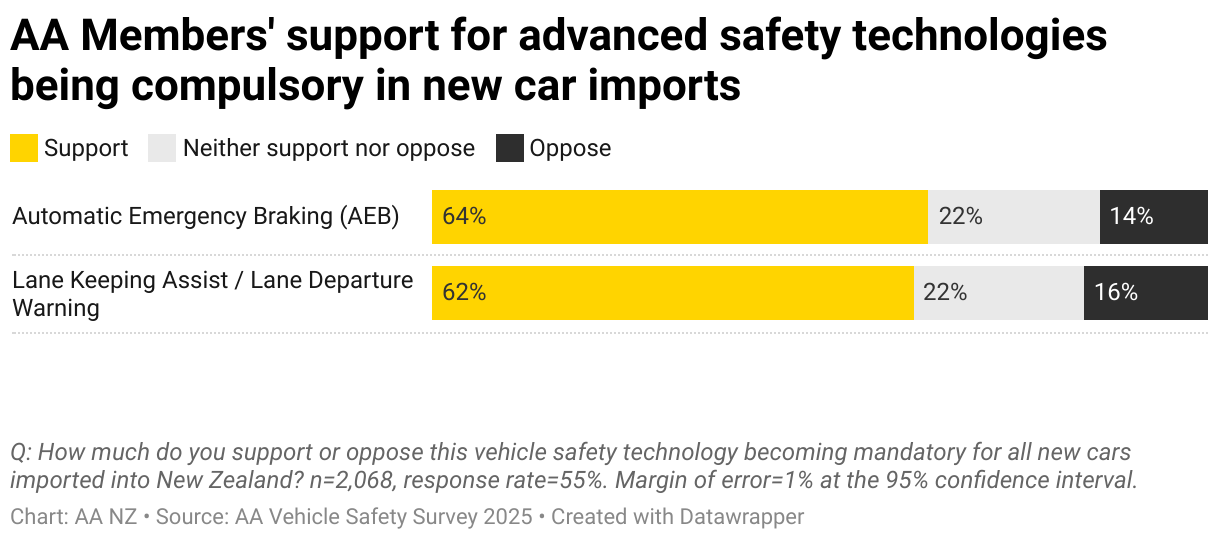
We found that the majority of AA Members supported making these vehicle safety technologies compulsory

  •  6 out of 10 (64%) of AA Members support making Automatic Emergency Braking (AEB) compulsory in new vehicle imports. 14% are opposed.
  •   6 out of 10 (62%) of AA Members Lane support making Lane Assist/Lane Departure Warning compulsory. 16% are opposed.
"Maintenance of roads and footpaths should be a priority  Roads slumping and potholes  Footpaths tree roots and lifting paths are so dangerous for the elderly and disabled." -AA Member, Taranaki
"I believe that the ramps from road to footpaths need to be smoother for mobility scooters. Many are just too steep or the step up too high." - AA Member, Whanganui
"Living in town there are a lot of areas that still lack footpaths altogether, which is quite worrying - particularly with one road which goes past the kura but still has no footpath.” -AA Member, Northland

AA Members support additional vehicle safety technologies being compulsory

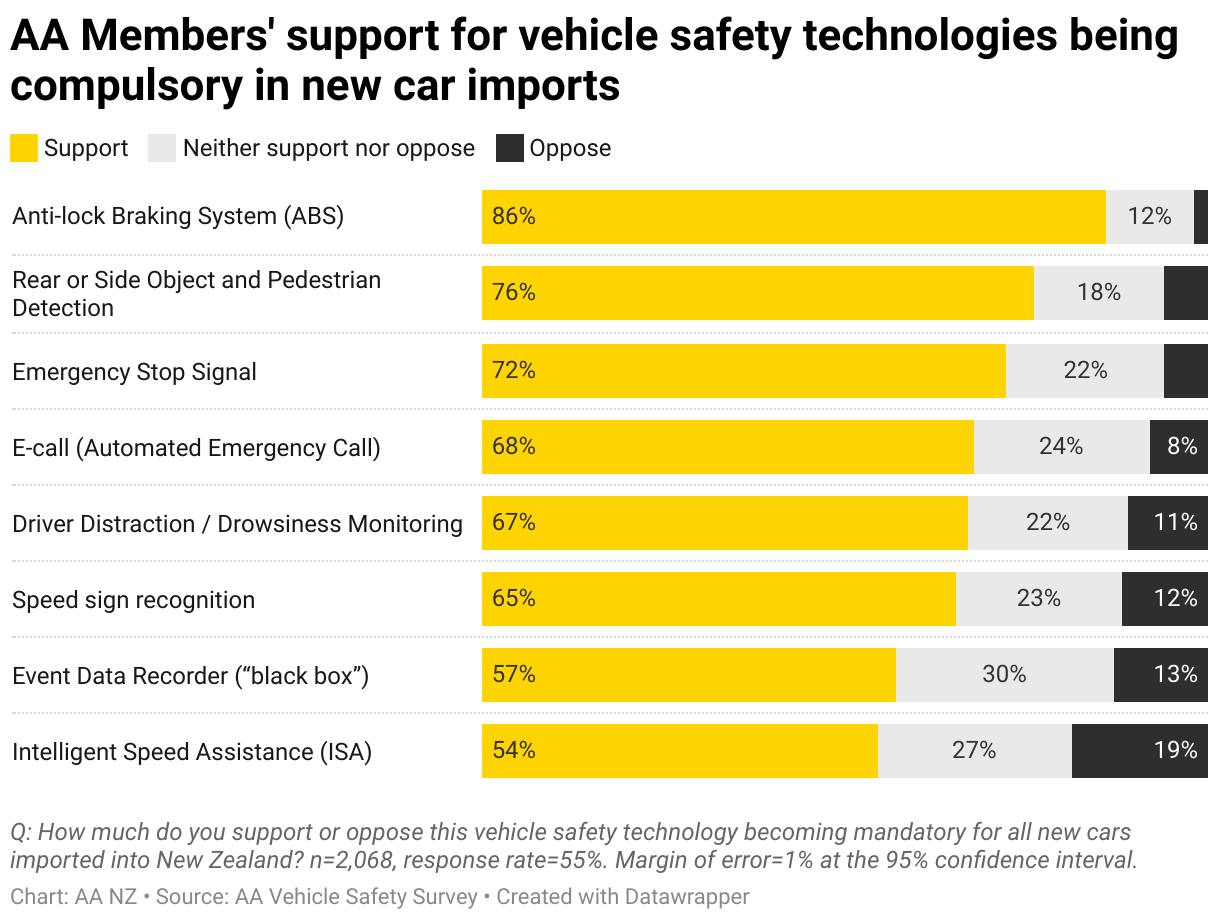
In addition to the technologies the Government is considering, we also asked AA Members if they supported a range of other advanced technologies that have been found to prevent or reduce the impact of crashes. 

More than half of AA Members supported additional safety features being compulsory for new vehicle imports.

The most popular vehicle safety technologies were:

  •  Anti-Lock Braking System (ABS) (86% support, 2% opposed). This technology prevents wheels locking under hard braking.
  • Rear or Side Object and Pedestrian Detection (72% support, 6% opposed). This detects people or objects behind or around the car and warns the driver
  •  Emergency Stop Signals (68% support, 6% opposed). This rapidly flashes brake or hazard lights under emergency braking to warn other drivers.

Over half support more safety requirements for used car imports

Many vehicles imported into New Zealand are used, and these are often older and less likely to have modern safety features. The government is considering whether to require advanced safety technology not just in new, but also in used vehicles entering the country. Many of these technologies are already standard overseas, including in the countries we import vehicles from.

We asked Members for their views on this proposal, which could help accelerate improvements in the overall safety of New Zealand’s vehicle fleet.

  • Over half (51%) support it being compulsory for used cars to have modern safety technology. 1 out of 5 (21%) were opposed.

AA Members support a phased rollout of new vehicle safety requirements for car imports

To minimise disruption to the supply of vehicles, the government is considering phasing in new safety requirements over time. We asked Members whether they support a phased approach.

  • 4 out of 5 (80%) support phasing in safety features over time (e.g. only for new car imports by a certain date), rather than all at once.

What are potential impacts on vehicle affordability?

AA Members would pay more for better vehicle safety technology, but affordability is a concern

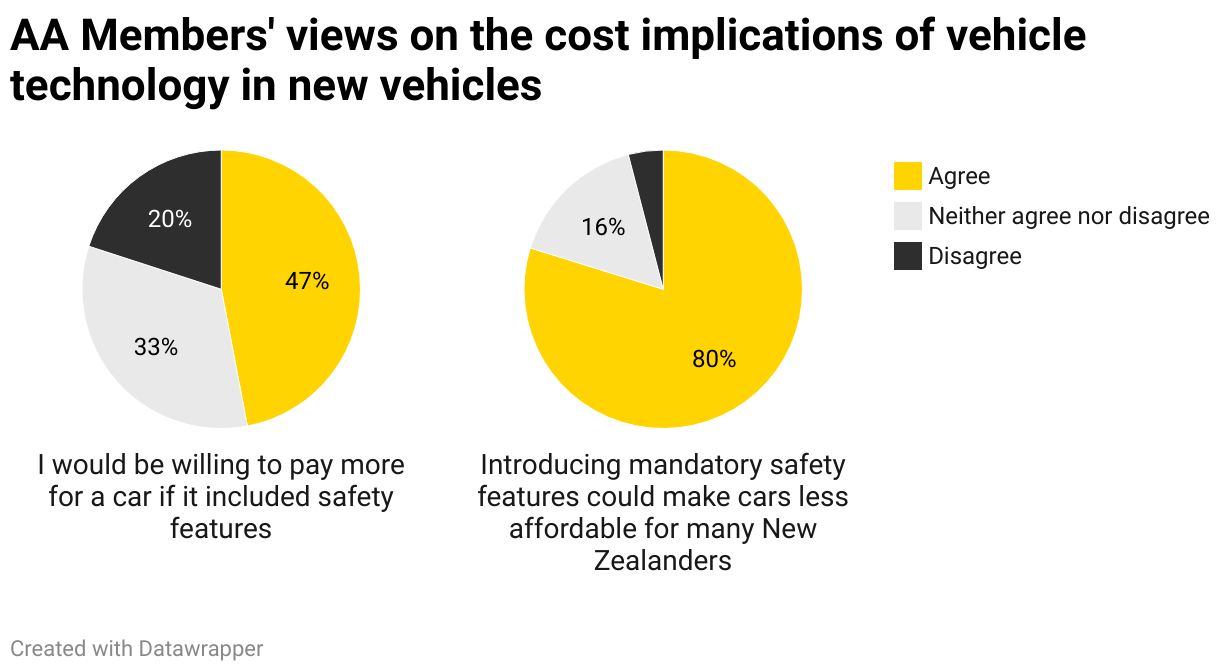
While modern safety technology can save lives, there are concerns that making these features compulsory could increase the cost of vehicles and affect affordability for many New Zealanders. We asked Members about their willingness to pay more for safer cars, and their views on the potential impact of new requirements on vehicle prices.

We found that:

  • Just under half (47%) would pay more for a car with safety features. 1 out of 4 (20%) would not pay more.
  •  4 out of 5 (80%) believe that introducing mandatory safety features could make cars less affordable for many New Zealanders.

Some AA Members were concerned about the additional costs due to technology failures, and were sceptical of road safety benefits:

“With more technology comes higher costs, more regular breakdowns and does not improve overall road safety. Will make vehicles less available and force people into mass transit.”  -AA Member

About the AA Vehicle Safety Survey

The Vehicle Safety Survey (October 2025) examined AA Members’ use of vehicle safety technology, and their support for making certain features compulsory for new and used imports.

It also included AA Members’ practices around maintenance, roadworthiness, and WoF compliance. It had a response rate of 55% (n=2,068 of 3,821), with a margin of error of ±1%.

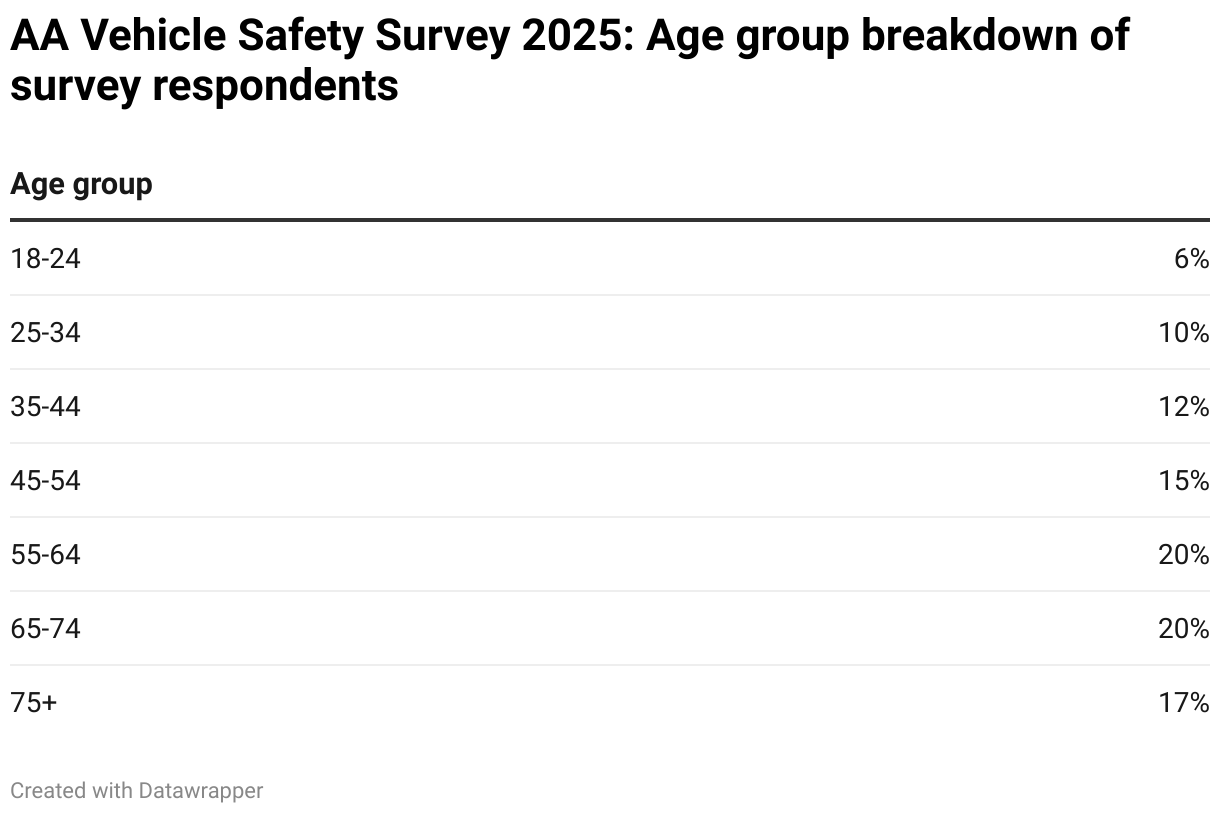
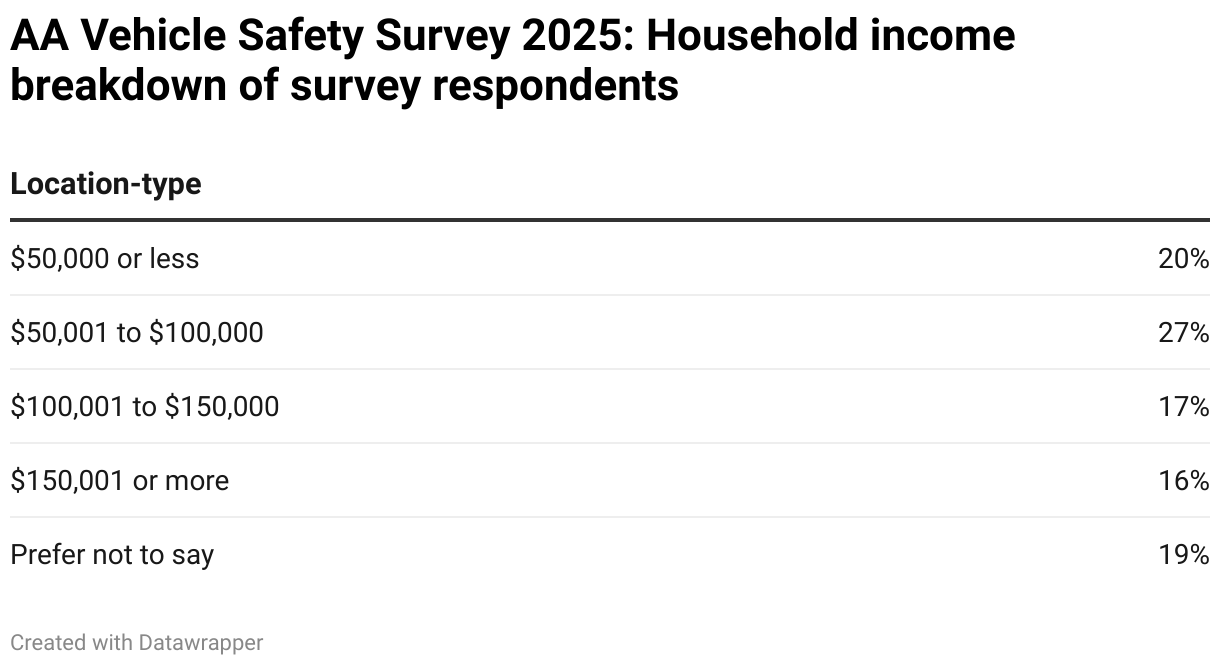
Results have been weighted to reflect the AA Membership by age, gender, and AA district.

These results helped inform the AA’s submission to the Government’s consultation in December 2025 on proposed updates to the vehicle safety technology that should be compulsory in new and used vehicle imports, as well as ongoing advocacy promoting vehicle safety.

We use Member feedback to guide our advocacy and ensure that our positions reflect the real experiences and concerns of AA Members. Alongside survey results, we also consider research evidence, our own policy analysis, and input from AA District Councils across New Zealand when responding to consultations and promoting improvements to transport policy.

Media contact and further information

  • For media enquiries, please contact the AA Manager of Research, Safety & Communications Dylan Thomsen, +64 4 931 9991
  • For information about the survey or further results, get in touch with our team at membervoices@aa.co.nz.
  • Visit the AA Transport Surveys to find out more about the survey programme.